SCHUMANN AND BRAHMS
Notes on the composers and the pieces
R. Schumann
Symphony No. 1 “Spring”
Johannes Brahms
Piano Concerto No. 2
Return to Home Page |
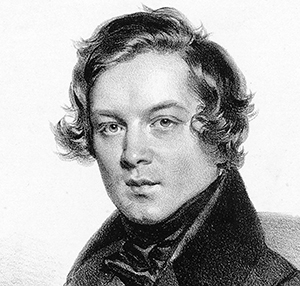
Robert Schumann
Robert Alexander Schumann (1810–1856) was a major figure among early German Romantic composers. He idolized Franz Schubert, was a friend of Felix Mendelssohn and Johannes Brahms, knew Frederic Chopin, Richard Wagner, and Hector Berlioz, and married one of the era’s great pianists, Clara Wieck. He is also considered a poet, not because his pieces were inspired by literary sources, but because their music was poetic.
Schumann was born in Zwickau, Saxony in eastern Germany. His father, August, was a bookseller, publisher, novelist, and translator known for his German editions of Sir Walter Scott and George Noel Gordon Byron (aka Lord Byron). Robert’s interest in literature was nurtured by writers he encountered in his father’s library, particularly Friedrich Schiller, Johann Wolfgang von Goethe, and Lord Byron.
The composer took piano lessons at an early age, but the main spark for his interest in music was a performance by pianist Ignaz Moscheles that he attended in his youth. He later enrolled in the Zwickau Gymnasium (a high school) where he composed short pieces and wrote poems and essays. His father hoped his son could study with Carl Maria von Weber, but his wish was thwarted by Weber’s death in 1826, the year when August died, and Robert’s sister Emilie committed suicide.
In 1828 Schumann moved to Leipzig, ostensibly to study law. He hoped that would satisfy his deceased father’s wish that his son would pursue an academic degree, though he spent most of his time reading, composing, writing fiction, taking general music and piano lessons with Friedrich Wieck, and meeting Wieck’s nine year-old daughter, Clara, a piano prodigy. In 1829 he enrolled in law school in Heidelberg where he repeated most of his Leipzig behavior while working on Abegg Variations for piano. Schumann’s summer travels through Switzerland and Italy had a strong effect on him as did hearing violinist Niccolò Paganini perform. To his mother he wrote, “My entire life has been a twenty-year struggle between poetry and prose, or call it music and law.”
In October 1830 he moved back to Leipzig and lived with the Wiecks until the Fall of 1831 when Clara and her father went on a seven-month concert tour. After they left, he moved out of their house and took lessons in harmony and counterpoint from German composer Heinrich Dorn. He also wrote music and poetry.
In 1832 problems with his right hand put an end to Schumann’s pianist ambitions and led him to his true callings of composing and writing. Zwickau Symphony (1833), an unfinished work, was his first major musical effort. After he returned to Leipzig, he was beset with a fever that led to mental instability and fear of madness. That and the deaths of his brother and sister-in-law nearly pushed him to suicide. Friendship with composer Ludwig Schunke helped him recover and compose Études Symphoniques. Schunke’s death later that year was another severe blow.
In 1834 Schumann helped start Neue Zeitschrift für Musik (New Magazine for Music), a journal that became a platform for his writing. That same year he became engaged to Wieck piano student Ernestine von Fricken, a relationship that ended when Clara, now fifteen, returned from a tour. In 1836 Robert composed Fantasy in C (rev. 1839), then Davidsbündlertänze and Phantasiestücke (1837), Kinderszenen, Kreisleriana, and Novelletten (1838); and Arabeske and Humoreske (1839)—all piano works.
In 1839, Schumann’s brother Eduard died, and for a while it appeared Robert would quit composing and take over the family’s publishing business. Clara was on tour at the time and had developed misgivings about Robert to the point where their relationship nearly came apart. Eventually they righted things enough to declare themselves engaged, but Clara was still a minor, and Wieck’s refusal to grant them permission to marry led to legal maneuvering that, combined with the loss of another close friend, pushed Robert into depression. Clara’s father made things so difficult that the couple considered moving to Vienna. After legal consent was finally granted for the marriage, the two were wed on September 12, 1840, the day before Clara came of age at 21. Three years later, her father made his peace with them.
Clara’s career provided the family’s financial support. The couple had eight children, with one dying an infant. She also shored up Robert’s emotional state and exerted a strong influence on his composing. In her opinion, “it would be best if he composed for orchestra; his imagination cannot find sufficient scope on the piano…His compositions are all orchestral in feeling…My highest wish is that he should compose for orchestra. That is his field! May I succeed in bringing him to it!” In time, Clara’s urging encouraged Robert to write four symphonies and other works.
According to her diary, Symphony No. 1 “Spring Symphony” was inspired by Frühlingsgedicht (Spring Poem) by the German poet Adolf Böttger. Following is David Paley’s translation of the poem.
You spirit of the cloud, dull and drear,
Who over land and sea with threats appear,
To cover all, once more, with your gray veil
Causing heavens clear eye to pale,
Your mist billowing from afar
As if the night would cloak love's star.
Spirit of the cloud,
in dim and damp display,
Why have you chased all my joy away,
Summoned tears upon my face
And light within my soul effaced?
Oh turn, turn your course away from here—
Spring now blossoms in the vale so dear!
Schumann wrote this symphony in early 1841. He originally titled each movement, but he withdrew them before the symphony was published. They were I: “The Beginning of Spring”; II: “Evening”; III: “Merry Playmates”; and IV: “Spring in Full Bloom”, described by the composer as a “summons to awakening” and “the vernal passion that sway men until they are very old, and which surprises them with each year.”
I. Andante un poco maestoso—Allegro molto vivace opens with a fanfarish summoning followed by music that is first slow, quick and good natured walking about, speeding up, and culminating in a happy flute line that leads to the lively main section. The final part reflects on material that suggests a springtime walk in the woods. It builds quickly, culminating with the opening fanfare played by the whole orchestra followed by a dash to the end. Worth noting is his advice about performing the work: “I should like the very first trumpet entrance to sound as if it came from on high like a summons to awakening. [Later] I would like the music to suggest the world’s turning green, perhaps with a butterfly hovering in the air, and in the Allegro, to show how everything to do with Spring is coming alive…”
II. Larghetto is peaceful, calm, prayer-like, and deceptively simple, as if the listener needs a rest from the lively first movement and time to think and reflect. It continues without pause to…
III. Scherzo: Molto vivace, a Beethoven-like minuet-and-trio movement whose two trios alternate with the main scherzo theme. From there the music dances in a “heavily rhythmic and buoyant—far more country fair than stately ballroom.” Of particular interest are the tempo changes with the fast, bubbling second Trio and the quirky stops and starts of the coda, similar to those seen in Schumann’s piano pieces Kinderszenen (Scenes from Childhood).
IV. Allegro animato e gracioso is a lively and tricky movement that begins with a big announcement. The strings then play a dance-like Mendelssohnian passage that lightens up in the violins with punctuation in the low strings followed by another dancing passage. The upper strings return, and most of this repeats. After a light woodwind passage is interrupted by a trombone call, the music seems to rise from the lowlands and pick up strength as it reflects on what has gone by until things come to a halt. The horns then take over followed by a flute cadenza, the Mendelssohnian dance music returns, and much of what has gone by repeats. Finally, the orchestra gathers itself, a solo trombone calls everyone together, and all bid a farewell to Spring and turn to the present.
The symphony was premiered by Felix Mendelssohn and the Leipzig Gewandhaus orchestra on March 31, 1841.
—Roger Hecht
Roger Hecht plays trombone in the Mercury Orchestra. He is a former member of Bay Colony Brass (where he was also the Operations/Personnel Manager), the Syracuse Symphony, Lake George Opera, New Bedford Symphony, and Cape Ann Symphony, as well as trombonist and orchestra manager of Lowell House Opera, Commonwealth Opera, and MetroWest Opera. He is a regular reviewer for American Record Guide, contributed to Classical Music: Listener’s Companion, and has written articles on music for the Elgar Society Journal and Positive Feedback magazine. His fiction collection, The Audition and Other Stories, includes a novella about a trombonist preparing for and taking a major orchestra audition (English Hill Press, 2013).
Return to Home Page |
