SCHUMANN AND BRAHMS
Notes on the composers and the pieces
R. Schumann
Symphony No. 1 “Spring”
Johannes Brahms
Piano Concerto No. 2
Return to Home Page |
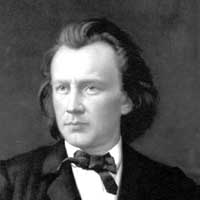
Johannes Brahms: Piano Concerto No. 2 in B-Flat Major, Op. 83
Johannes Brahms (1833–1897) was one of the leading composers of late German Romanticism, but his early career in his native Hamburg, Germany did not start that way. Fortunately, he was helped by several important friends. Violinist Joseph Joachim helped him meet Franz Liszt and Robert and Clara Schumann. Robert advised him to write something like a Beethoven symphony and thereby become “the Chosen One.” Schumann died in 1856, but Clara remained a strong supporter and friend of Brahms.
In 1859 Brahms established the Hamburger Frauenchor, a women’s choir, hoping to gain experience leading to more advanced positions. His plan was for one of those positions to be the conductor’s post of the Hamburg Philharmonic. When that fell through he moved to Vienna hoping that the experience gained there would make him a more attractive candidate with the Hamburg directors. That effort became moot when he remained in Vienna, composing, performing, and leading concerts of the Vienna Gesellschaft der Musikfreunde (Society for the Friends of Music) until 1875.
In time he worked almost entirely as a composer comfortable with most musical forms save the tone poem, organ, ballet, and most notably opera. The style of his music was planted amid the ongoing conflict between the Romantic German style of Schumann and Felix Mendelssohn and the New German School of Anton Bruckner and Richard Wagner. In fact, Brahms’s music, particularly his harmony, was more progressive than most people thought, to the point where Arnold Schoenberg praised him, and Anton Webern credited him with anticipating the atonal Second Viennese School.
Brahms wrote most of his major orchestral works relatively late in his career. One reason was that he was insecure about his ability to write a symphony, which he considered the highest form of orchestral writing. As with many composers of his era, the image of Beethoven loomed over composing of symphonies. Nevertheless, Schumann encouraged him to start one. Brahms did so with his First Piano Concerto, which was initially conceived and developed as a symphony. The piano concerto was not well received in Leipzig in 1858, with Brahms as the soloist. He may have tried again with a sketch he gave Clara Schumann in 1862, but he apparently destroyed whatever he had written and turned to writing chamber works, songs, piano pieces, and Ein deutsches Requiem. It was not until 1876 that he finished Symphony No. 1, the work that established him as a major composer.
In April 1878, Brahms went on the first of nine journeys to Italy. He was accompanied by Theodor Billroth, a highly respected surgeon and amateur musician. When he returned home he was full of energy and ready to write a Violin Concerto for Joseph Joachim. Along the way he dropped his plan to include a scherzo, apparently at Joachim’s suggestion, but the sketches he made for one evolved to become the starting point of the second movement of his Piano Concerto No. 2. 1881 was filled with the premieres of Academic Festival Overture and Nänie, a setting of Friedrich Schiller’s poem (after the Roman goddess Nenia) in memory of his friend, painter Anselm Feuerbach.
Composing Piano Concerto No. 2 in B-flat was not an easy task. Brahms dedicated it to Eduard Marxsen, his childhood music teacher whom Brahms revered. The composer long believed that what he had accomplished with that concerto grew out of what Marxsen had taught him long ago. He reported to Elisabeth von Herzogenberg, perhaps his closest musical confidante of those years, that he had finished a “tiny, tiny piano concerto with a tiny, tiny wisp of a scherzo.” The score of the piece that he sent to Billroth referred to it as “a bunch of little piano pieces.”
Brahms was 48 when his Piano Concerto No. 2 appeared. “…[A] second one will sound very different,” he confessed to Joseph Joachim after the disastrous premiere of his first piano concerto. Its premiere was in Budapest on November 9, 1881, with Brahms as soloist accompanied by the Orchestra of the National Theater, conducted by Alexander Erkel. Later, when he played the work on a tour of Germany with Hans von Bülow conducting the Meiningen Orchestra, it was well received everywhere but Leipzig.
Piano Concerto No. 2 is sometimes referred to as a “symphony with piano obbligato,” particularly the first movement (Allegro non troppo). In some ways it sounds more like the opening to a symphony than a concerto. It begins as a conversation between the piano and French horn, followed by winds, then the strings. After the piano returns and goes over the orchestra material, the two get together and converse. A martial passage in the horns soon moves around the orchestra and ends with the piano, somewhat like commentary. A cadenza-like passage in the strings leads to a musing section with piano (mainly) and orchestral commentary. The second movement, Allegro appassionato, opens briskly and approaches tempestuous. After the strings enter calmly, the piano takes the hint and follows suit for a while but eventually becomes more rhythmic and aggressive. After some back-and-forth, the strings begin a melodic passage until the piano takes over with another cadenza. This time the strings respond with a little march, and the piano produces a passage that is almost decoratively aggressive. The third movement, Andante, begins with a warm cello solo that leads to a soulful and reflective orchestral passage. There is a lot of similar material in the strings plus some decorative piano accompaniment and a quiet ending. The finale (Allegretto grazioso), is light-hearted, conversational, and busy in a way that provides relaxation after the earlier movements.
—Roger Hecht
Roger Hecht plays trombone in the Mercury Orchestra. He is a former member of Bay Colony Brass (where he was also the Operations/Personnel Manager), the Syracuse Symphony, Lake George Opera, New Bedford Symphony, and Cape Ann Symphony, as well as trombonist and orchestra manager of Lowell House Opera, Commonwealth Opera, and MetroWest Opera. He is a regular reviewer for American Record Guide, contributed to Classical Music: Listener’s Companion, and has written articles on music for the Elgar Society Journal and Positive Feedback magazine. His fiction collection, The Audition and Other Stories, includes a novella about a trombonist preparing for and taking a major orchestra audition (English Hill Press, 2013).
Return to Home Page
|
