PERRY, SCHUMAN, AND HARRIS
Notes on the composers and the pieces
Julia Perry
Short Piece for Large Orchestra
William Schuman
A Free Song
Roy Harris
Symphony No. 6 “Gettysburg”
Return to Home Page |
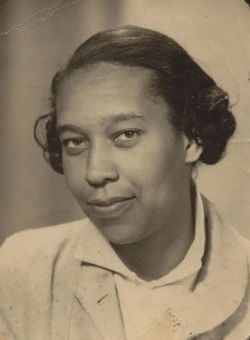
Julia Perry: Short Piece for Large Orchestra
African-American composer, pianist, conductor, and teacher Julia Amanda Perry (1924–1979) was born in Lexington, Kentucky, grew up in Akron, Ohio, and was raised by musician parents. Her father was a physician, but he was also a composer and pianist who accompanied African-American tenor Roland Hayes on some of his tours. Her mother was a schoolteacher who encouraged her children to play violin. Julia also studied piano, composition, conducting, and earned recognition as a vocalist. She earned scholarships to attend Westminster Choir College in Princeton, New Jersey where she studied composition, conducting, voice, piano, and violin. Her master’s thesis was her secular cantata Chicago. In 1948 she won first prize in both Composition and Voice in the annual National Association of Negro Musicians competition. She also spent a year on the faculty at Hampton Institute in Virginia teaching composition, theory, orchestration, and voice.
From 1949 until 1951, Perry lived in the International House in New York City, a residential program for graduate students. While there, she took classes at the Juilliard School, studied voice at the Curtis Institute in Philadelphia and was awarded a scholarship to participate and coach at the Columbia University Opera Workshop. In addition, her singing was admired in the Marian Anderson Award competition. Around that time, she met Italian composer Piero Bellugi, who was impressed enough by her Stabat Mater score to introduce her to composer Luigi Dallapiccola who would be her mentor for several years. Following a summer at Tanglewood in 1951, she moved to Italy to continue her studies with Dallapiccola. After earning a Guggenheim Fellowship, she studied with Nadia Boulanger at the American Conservatory of Paris. In 1952, she won the Boulanger Grand Prix for her Viola Sonata. A second Guggenheim allowed her to return to Italy where she studied conducting at the Accademia Musicale Chigiana Siena during the summers of 1956 and 1957. She was then sponsored by the U.S. Information Service to conduct a series of concerts in Europe. After returning to the United States, she taught at Tallahassee’s Florida Agricultural and Mechanical College and was a visiting artist at Atlanta College. Later, she traveled back and forth between the United States and Italy and then returned to Akron to compose.
Perry’s life was not without tragedy. In 1971, the first of several strokes left her paralyzed on her right side and unable to speak. She responded by learning how to write with her left hand so she could continue composing, but getting her work published was difficult because it was almost impossible for publishers to read her post-stroke handwriting. In the end most of her music was either lost after her death or available only in manuscript form.
Julia Perry combined European classical and neoclassical training with her African-American heritage. Her music blends 20th Century neoclassical Western techniques like dissonance and quartal harmony with influences of her African-American heritage, particularly the blues. Many of her early works were vocal pieces reflecting African-American spirituals, e.g., “Free at Last,” “I’m a Poor Li’l Orphan,” and “Song of Our Savior.” Others include The Symplegades (based on the Salem witchcraft trials), Five Quixotic Songs for bass baritone, Bicentennial Reflections for tenor solo, and an operatic ballet based on Oscar Wilde’s The Selfish Giant, for which she was honored by the National Institute of Arts and Letters in 1964. Her orchestral works include twelve symphonies, two piano concertos, a violin concerto, Requiem for Orchestra (also known as Homage to Vivaldi because of its themes inspired by Antonio Vivaldi), and many shorter pieces. She also wrote three operas: The Bottle, The Cask of Amontillado, and Three Warnings. Some of her work was well received in the 1960s after performances by the New York Philharmonic and other major orchestras.
A Short Piece for Orchestra is one of Perry’s most popular works. She wrote it in 1952 while in Italy, and its premiere was played there. Its final revision is for full orchestra and was premiered by the New York Philharmonic on May 6, 1965, as Study for Orchestra. It was the first work by a woman of color and the third by any woman to be performed by the New York Philharmonic. The piece is an orchestral alarm with various elements clamoring for attention. It begins with an insistently urgent figure then gives way to a flute soliloquy that is answered by several woodwind solos before finding a home in the French horn. Soon the early alarm music and anxiety give way to slower music until the tempo picks up gradually, and muted trumpets sound a second alarm. A skipping rhythm and dissonant chords slow things down until the alarm figure returns amid mild chaos. A long somber string passage is followed by a sad lament, another flute solo, and some eerie string solos. Sadness returns, and the tempo picks up leading to a blunt conclusion.
—Roger Hecht
Roger Hecht plays trombone in the Mercury Orchestra. He is a former member of Bay Colony Brass (where he was also the Operations/Personnel Manager), the Syracuse Symphony, Lake George Opera, New Bedford Symphony, and Cape Ann Symphony, as well as trombonist and orchestra manager of Lowell House Opera, Commonwealth Opera, and MetroWest Opera. He is a regular reviewer for American Record Guide, contributed to Classical Music: Listener’s Companion, and has written articles on music for the Elgar Society Journal and Positive Feedback magazine. His fiction collection, The Audition and Other Stories, includes a novella about a trombonist preparing for and taking a major orchestra audition (English Hill Press, 2013).
Read about William Schuman
|
